
The 'rescue' operation occurred within kilometres of Iran's underground tunnel complex at Isfahan, assessed by the IAEA and US intelligence as holding a substantial portion of the country's 60 per cent enriched uranium stockpile. Retired senior US military officers have highlighted that the mission's footprint -- hundreds of special operators, multiple heavy-lift aircraft deep inside Iran -- appears outsized for recovering a single airman. Prem Panicker continues his must read blog on the Iran War.

When missiles fly in this region, they are never just aimed at military targets.

Now that almost 10 infrastructure ministries have submitted a fresh list of their core infrastructure assets, the government has realised it stands to make much more money from asset monetisation than previously thought. Two persons in the government said it stood to garner over 30 per cent more than the earlier estimates of Rs 2.5 trillion over the next four years under the National Monetisation Pipeline (NMP). The NMP, which is being prepared by Niti Aayog, is in the advanced stages of finalisation and is expected to be unveiled in August.
India's market regulator is moving ahead to include real estate investment trusts (Reits) in benchmark indices in a phased manner, Sebi chief Tuhin Kanta Pandey said, while asserting that the regulator was working to strengthen the link between infrastructure building and the markets.

Ahmedabad proposed as host city for 2031 World Athletics C''ships and 2028 World U20 C''ships

"The budget adopts following seven priorities -- inclusive development, reaching the last mile, infrastructure and investment, unleashing the potential, green growth, youth power and financial sector," she said.

I am inclined to believe that the Venezuela adventure is not an indication of American strength, alas, but rather of American weakness, points out Rajeev Srinivasan.

'The BNP's election manifesto lists grievances against India, mirroring the attitude of past BNP governments.' 'Political parties have been careful not to say bad things about China.'

Across all sectors, the future of work depends on adaptability.

Infrastructure funds, which bet on stocks closely linked with infrastructure development in the country, have emerged as one of the best-performing categories over the past year. They have generated an average return of 90.63 per cent - the third-best, after technology funds and small-cap funds. Of the 21 schemes in the category, seven have given a return of more than 100 per cent in a year.

Karnataka Chief Minister Siddaramaiah met Prime Minister Narendra Modi and insisted on demands pertaining to the state, including on Fair Recovery Price of sugarcane, All India Institute of Medical Sciences for Raichur, the release of flood relief among others.
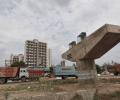
These could include strengthening the public-private partnership (PPP) dispute resolution mechanism, uniform PPP institutional framework, easier terms for infrastructure companies accessing bond markets, and tax sops, Business Standard has learnt. Investment in infrastructure projects with high multiplier effect has been the Centre's main plank to revive the economy, create employment and boost consumption.

The Department of Investment and Public Asset Management (Dipam) has asked ministries, government departments, and public sector undertakings (PSUs) to send a list of assets that can be monetised under the proposed National Monetisation Pipeline. The list will be used for creation of an asset monetisation dashboard, which will keep a track of such assets. The government, meanwhile, has asked CRISIL to prepare a road map for monetising assets of PSUs and government departments.

If they act now, they can reshape the strategic map of Asia without firing a shot. If they wait, the next opportunity will come only after a serious Taiwan Strait incident -- by which time the price will be far higher, and the room for boldness far smaller -- the opportunity may well be lost by then. The question is no longer whether this can or should be done, points out Varun Arya.

Finance Minister Nirmala Sitharaman on Tuesday said monetisation of Central Public Sector Enterprises (CPSE) assets is based on the principle of value creation for the government and investors and would bring about a paradigm shift in infrastructure augmentation and maintenance. Chairing the National Workshop with the states/UTs on Asset Monetisation organised by Niti Aayog, the minister sought the collaboration of states for the holistic development of infrastructure. She said India can become a $5 trillion economy, while striking the right balance between fiscal imperatives and socio-economic welfare, through active collaboration between the public and private sector.

'Don't look at Russia only as a place to earn quickly and then leave.' 'Try to build experience in serious companies, skills and certifications that will serve you anywhere in the world.'

India's mergers and acquisitions (M&A) activity cooled in the second quarter of 2025-26 (Q2FY26), with deal value falling to $26.26 billion from $29.04 billion a year ago, according to Bloomberg data.
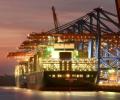
The government has identified 50 public-private partnership (PPP) projects worth over Rs 60,000 crore, significantly surpassing the original targets of the National Monetisation Pipeline, said Ports, Shipping, and Waterways Minister Sarbananda Sonowal at the Business Standard Infrastructure Summit on Thursday.

An obscure US-based firm with just 19 employees, USD 15 million in revenue and hosting just a one-page website, wants to invest USD 500 billion in equity into India's National Infrastructure Pipeline (NIP).

Top real estate developers are expected to report improved earnings and resilient presales growth, even as overall housing sales across major Indian cities declined during the July-September quarter (Q2) of 2025-26. The anticipated earnings growth in what is typically a subdued quarter is credited to steady sustenance sales, improved collections, the strong positioning of listed developers, and sustained demand for premium homes.

Finance Minister Nirmala Sitharaman on Monday announced a Rs 6 lakh crore National Monetisation Pipeline (NMP) that will look to unlock value in infrastructure assets across sectors ranging from power to road and railways. She also said the asset monetisation does not involve selling of land and it is about monetising brownfield assets. Projects have been identified across sectors, with roads, railways and power being the top segments.
The government has developed an asset monetisation dashboard for monitoring real-time progress of its ambitious Rs 2.5 trillion-plus pipeline, and providing visibility to investors. The portal has been prepared as the government tries to provide a one-stop shop to investors keen on taking over assets of government departments and ministries.

Terming investment in infrastructure "quintessential" to boost growth, the Economic Survey on Friday said post unlocking of the economy, infra sectors are poised for growth and construction of roads is expected to return to the high pace attained before COVID-19. The infrastructure sector will be the key to overall economic growth and macroeconomic stability, the Survey said emphasising that the year after the crisis (2021-22) will require sustained and calibrated measures to facilitate the process of economic recovery and enable the economy to get back on its long-term growth trajectory. "Basic infrastructure facilities in the country provide the foundation of growth. In the absence of adequate infrastructure, the economy operates at a suboptimal level and remains distant from its potential and frontier growth trajectory.

India's economy is likely to grow by 6.5 per cent in the current and the next financial year, an EY report said, attributing lower than anticipated expansion in the September quarter to fall in private consumption expenditure and gross fixed capital formation. Real GDP growth eased to a seven-quarter low of 5.4 per cent in July-September -- the second quarter of the current 2024-25 fiscal year.

'The Bhashini Mission has delivered a working technology at large scale, which is as good as or better than the one with MNC tech giants.'

As spending on infrastructure has three times the desired impact, the government's Rs 111 trillion National Infrastructure Pipeline should be accelerated: Assocham president, Vineet Aggarwal
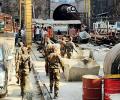
'Balancing tunnel developments with ecological realities is a major challenge and, when overlooked, can contribute to mishaps.'

'Although we are facing constraints related to lending and resource mobilisation, the government is aware of these.'

The Cabinet has cleared a Bill to set up a government-owned development finance institution (DFI) with initial paid-up capital of Rs 20,000 crore so that it can leverage around Rs 3 trillion from the markets in a few years to provide long-term funds to infrastructure projects as well as for development needs of the country. To put it in perspective, Rs 3 trillion constitutes slightly less than 3 per cent of the Rs 111 trillion to be spent on over 7,000 projects in the National Infrastructure Pipeline from 2019-20 to 2024-25. Besides, the government will give Rs 5,000 crore as grant to the institution, Finance Minister Nirmala Sitharaman on Tuesday told the media after the Cabinet meeting.

The MiG-21 episode demonstrates that procurement is always strategic.
Choices about what aircraft to acquire, who builds them, who supplies the spares, who trains the pilots and technicians are decisions with political consequences lasting for decades.

This includes an infrastructure push which may lead to the government spending more than its budgeted capital expenditure for 2020-21. There are also discussions on increasing the scope and quantum of direct cash transfers to the beneficiaries who need it the most.

'Despite being a software powerhouse, we're not producing proportionate original IP, frameworks, or global tech products originating in India.'

Outlay for infra is also expected to see a significant increase in view of the government's Rs 111-trillion investment plan under the national infrastructure pipeline to develop social and economic infrastructure over five years.

Finance Minister Nirmala Sitharaman on Tuesday highlighted "significant reforms" undertaken by the government including National Monetisation Pipeline (NMP) and National Infrastructure Pipeline (NIP) as she met institutional investors in Boston. Sitharaman arrived in the US on Monday for a week-long trip to attend the annual meet of the World Bank and IMF in Washingon as well as G20 Finance Ministers and Central Bank Governors (FMCBG) meeting. During the official visit to the US, Sitharaman is expected to meet US Treasury Secretary Janet Yellen.

Seven rivers, including the Brahmaputra, were flowing above the danger level, even as the Regional Meteorological Centre (RMC) in Guwahati predicted heavy to very heavy rainfall at isolated places in the state.
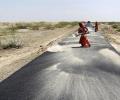
Accelerated development of highways will be taken up with 2,500 km access controlled highways and 9,000 km of economic corridor. In addition, there will be 2,000 km each of strategic highway projects and port connectivity projects, she said.

Prime Minister Narendra Modi on Wednesday launched a Rs 100 lakh crore national master plan for multi-modal connectivity that aims to develop infrastructure to reduce logistic costs and boost the economy. PM Gati Shakti targets to cut logistic costs, increase cargo handling capacity and reduce the turnaround time, Modi said at a function to launch the plan. The plan aims to lend more power and speed to projects by connecting all concerned departments on one platform, he said, adding the infrastructure schemes of various ministries and state governments will be designed and executed with a common vision.
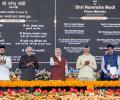
'Amaravati will be a game changer for Andhra Pradesh.'

The government, under the Finance Act, 2020, had allowed tax exemption for SWFs and pension funds in the case of incomes from investment in 34 key infrastructure sectors, including hotels, cold chains, educational institutions, hospitals, and gas pipelines.

These are the highlights of the Union Budget 2025-26 presented by Finance Minister Nirmala Sitharaman in Parliament on Saturday.
